
Journey To ChinaLast updated
Yuanmingyuan Ruins Park guide
An imperial residence built through several reigns
The Kangxi emperor granted the original garden to his son, the future Yongzheng emperor. Yongzheng expanded it as both a residence and a place of government; Qianlong later added Changchun Garden and Qichun Garden, creating the Three Gardens of Yuanmingyuan. Court painting, copied Jiangnan scenery, Tibetan Buddhist buildings and European fountains existed within one enormous managed landscape.
Water and terrain are the surviving framework
Most buildings were timber, but the shaped lakes, islands, embankments and paths still preserve the garden's spatial logic. The Jiuzhou group formed nine islands around a lake near the political and residential core. Fuhai created a much larger open-water scene. Walking between them shows how intimate courtyards and broad water views were deliberately alternated.
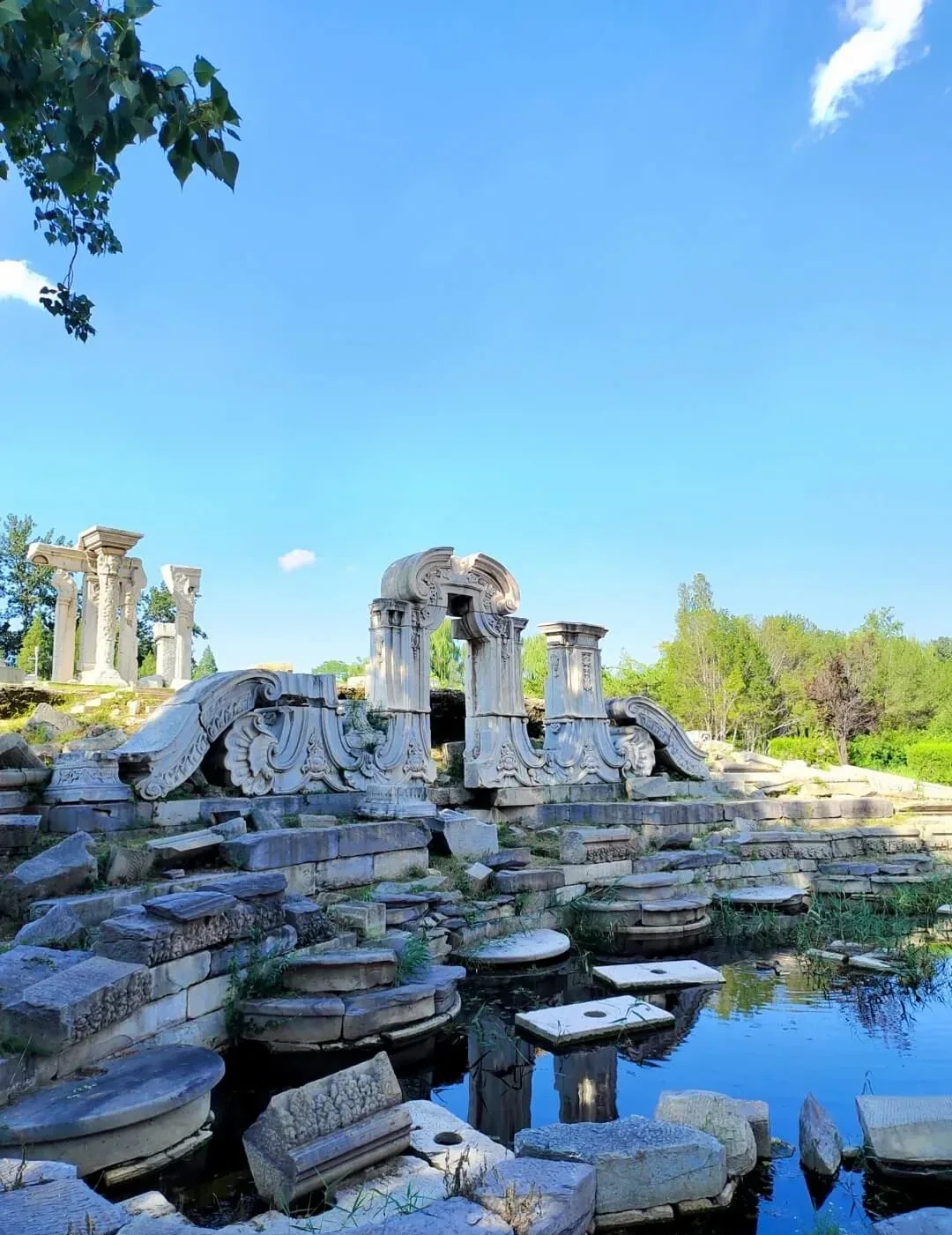
The famous stone fragments survive because the Western Mansions used masonry. They represent one small, unusual corner of a garden that was otherwise largely Chinese in material and planning.
The Western Mansions joined European form to Qing court spectacle
Giuseppe Castiglione and other Jesuit specialists worked with Chinese craftsmen on palaces, façades, fountains and mechanical waterworks. Dashuifa was the main fountain group; Haiyantang was associated with a water clock using twelve zodiac figures. The surviving masonry makes this area easy to photograph, but roof timbers, interiors, metal fittings and hydraulic equipment have disappeared.
Destruction continued long after the fire of 1860
Anglo-French forces looted and burned the gardens in 1860 during the Second Opium War. Further damage, removal of materials and occupation followed over later decades. The result was not one frozen ruin created in a single night, but a long process of loss. Archaeology, recovered plans, the surviving Zhengjue Temple and displays of excavated remains help visitors reconstruct what no longer stands.
The park is large enough for several different visits. The East Gate suits a focused Western Mansions route; the South Gate leads more naturally into the broader water system and Jiuzhou area. Lotus covers many lakes in summer, while leafless winter views reveal embankments and foundations more clearly. The Summer Palace can be paired as a separate, living imperial garden, useful precisely because its buildings and landscape survive in a very different state.