
Journey To ChinaLast updated
Start with the location and room, not the stars
Hotel searches in China mix terms such as economy, midscale, upscale, four-diamond and four-star. They do not all mean the same thing.
China has a formal one-to-five-star system for tourist hotels. A property must apply, be assessed and undergo reviews to hold that rating. Economy, midscale and upper-midscale describe where a chain sits in the market. Stars, diamonds and class labels on a booking platform may use the platform's own system. Atour is commonly positioned as upper-midscale, JI Hotel as midscale, while HanTing and the core Home Inn brand are economy choices. None of those labels proves that every branch holds a particular official star rating.
The individual property matters more. Check when it opened or was last renovated, the room size, whether the window faces outdoors, soundproofing, air conditioning, breakfast, laundry facilities, distance from the metro and reviews from the past few months. Two branches of the same chain can feel quite different.
A rough guide to prices
These ranges are for planning an ordinary non-holiday stay. They are not fixed brand prices or a promise of availability. Central Beijing, Shanghai and Shenzhen cost more, and rates can jump during Spring Festival, the National Day holiday, trade fairs, concerts and busy weekends.
| Type of stay | Typical position | Rough budget | Often suits |
|---|---|---|---|
| Hostel bed or very basic guesthouse | Lowest budget | RMB 60 to 200 | Solo travellers comfortable with shared spaces |
| HanTing, core Home Inn and similar chains | Economy | RMB 180 to 400 | Travellers who need a clean room, private bathroom and useful location |
| JI Hotel and similar chains | Midscale | RMB 300 to 650 | Multi-night stays with more consistent rooms and shared facilities |
| Atour and similar chains | Upper-midscale | RMB 400 to 900 | Travellers who care more about bedding, breakfast, laundry and common areas |
| Upscale and luxury hotels | Upscale, luxury or formally star-rated | RMB 700 to 2,000 and above | Travellers who need concierge, dining, a gym, pool or more English support |
| Homestay or serviced apartment | Varies widely | RMB 200 to 1,000 and above | Families, groups, longer stays and rural or old-town trips |
Atour reported an average daily rate of about RMB 424.4 for 2025. That helps place the brand in the market, but it is not the price of a room in a particular city on a particular date. Compare live prices for the same area and dates before setting the final budget.
Choosing a familiar hotel chain
Atour: more attention to sleep and common areas
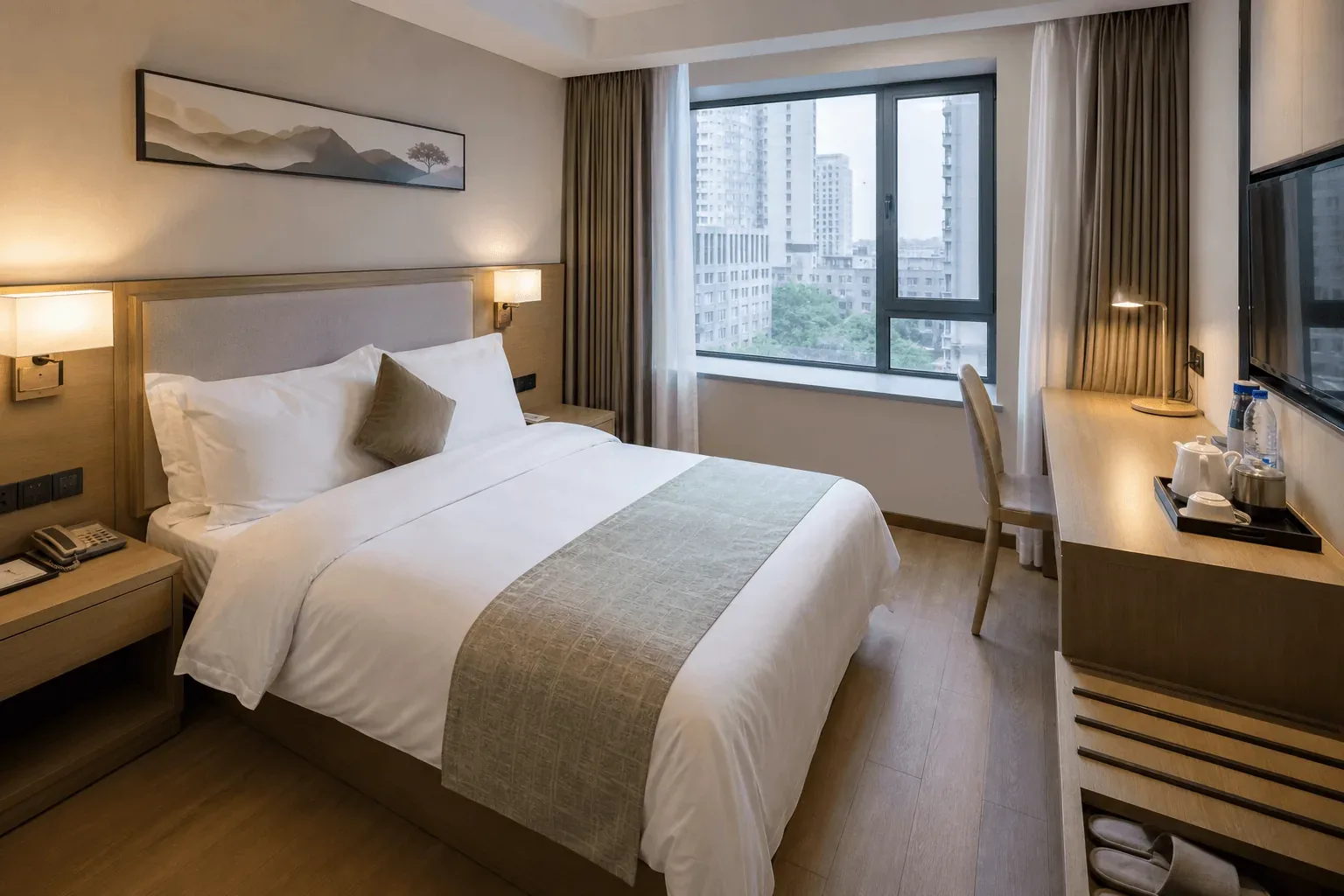
The main Atour Hotel brand is upper-midscale. A standard branch usually has more shared space than an economy hotel. Breakfast, self-service laundry, a small gym and a reading area are common, and the company puts considerable attention on bedding. It can work well for several nights or for a guest who needs to work from the hotel.
Atour also operates several sub-brands, and older and newer branches do not have identical rooms. Check the floor area, window type, breakfast inclusion, laundry hours and recent reviews. The name alone is not enough.
JI Hotel: a practical midscale choice
JI Hotel belongs to H World and sits in the midscale category. Rooms tend to use a simple design, and branches are common in large cities and around transport hubs. Self check-in, laundries and delivery robots appear often, but they are not guaranteed at every property.
JI suits travellers who want more comfort than an economy chain without paying for the full service of an upscale hotel. Many cities have several branches with nearly identical names. Check the complete property name, metro station and map pin before booking.
HanTing: budget first, with extra attention to property age
HanTing is H World's economy brand. It provides relatively standard basics such as a private bathroom, air conditioning, Wi-Fi and a staffed reception. Rooms can be compact. Breakfast, laundry and smart-room features depend on the branch.
The large network is useful for an early train, a busy sightseeing schedule or a one-night stop where the room is mainly for sleep. Older and newly updated HanTing properties can differ sharply. Look at the opening or renovation year, guest photos, and recent comments about cleanliness and noise.
Home Inn: check which Home Inn you are booking
BTG Homeinns operates the core economy Home Inn brand as well as upgraded lines such as Home Inn Selected and Home Inn Business. Their prices, room sizes and common facilities are not the same. A listing that includes the words Home Inn does not automatically sit in one fixed category.
The core brand is usually the budget option. Selected and Business properties tend to sit closer to midscale. Read the full brand name on the property page, then check photos of the exact room type before paying.
Other common choices
Orange Hotel, Crystal Orange, Novotel and Mercure cover parts of the midscale-to-upscale market. Hilton, Marriott, Hyatt, IHG, Shangri-La and Chinese upscale brands usually have fuller dining, concierge, fitness and meeting facilities. English-speaking staff are also more likely, though not guaranteed on every shift.
A higher room rate does not fix a poor location. A midscale chain beside the right metro station can save more time than a luxury hotel that requires a long transfer every morning.
What hotel delivery robots actually do
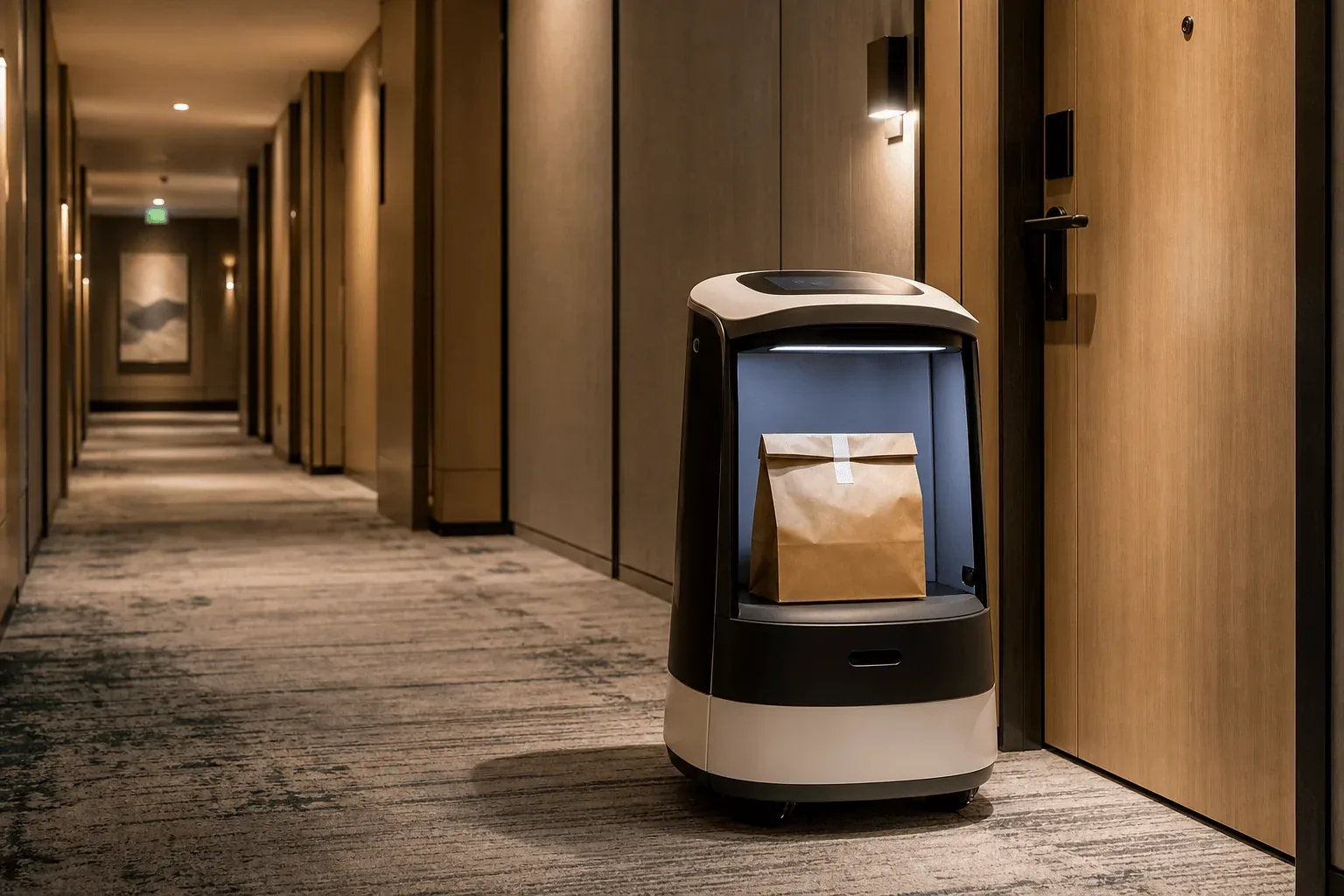
Many hotels use service robots for takeaway food, bottled water, toothbrushes and other small items. A courier usually leaves the order at reception or loads it into the robot. The robot takes the lift, reaches the correct floor and calls the room or sends a system alert. It delivers food; it does not prepare it.
This is a property-level facility, not a chain-wide promise. If the robot is busy, under maintenance or unable to enter a floor, staff may deliver the item or ask the guest to collect it in the lobby. Search recent reviews and guest photos for robot or food delivery, then confirm the arrangement at reception.
Cheaper inns and hostels
Hostel dormitories, small inns and guesthouses cut the room bill and can make it easier to meet other travellers. The trade-offs may include shared bathrooms, weak soundproofing, no lift, limited reception hours and little English support.
Check whether the listing is for one dorm bed or a private room. Read the mixed or single-gender dorm rules, locker and towel policy, laundry access, door curfew and latest check-in time. With a large suitcase, check the floor and lift as well. A very cheap property with few reviews is a poor choice for a first night in China after a late arrival.
Homestays and serviced apartments
Homestays work well in old towns, rural areas, around scenic sites and for groups. A serviced apartment can be useful when a kitchen, washing machine or several weeks of space matter. Both depend more heavily on the individual host and property than a standard chain does.
Before paying, confirm the exact address, check-in method, host or reception hours, luggage storage, lift, heating or air conditioning and whether the kitchen is actually available to guests. Make sure the photos show the room being sold. In an old neighbourhood, hutong or mountain town, a claimed five-minute walk may include stairs, narrow lanes or a section that cars cannot reach.
Accommodation registration works differently outside a hotel. Under the current rules, a foreign visitor staying in a homestay, short-term apartment or private home must complete accommodation registration within 24 hours, either personally or with the host. Online registration has been piloted since 20 March 2026 in Hebei, Liaoning, Zhejiang, Hubei, Guangxi, Chongqing and Sichuan. Do not assume the online process is available nationwide. Ask the host to explain exactly how they will help before booking.
Where to book
Trip.com is the simplest starting point
Trip.com has a multilingual interface, international payment methods and a large inventory of Chinese hotels. Addresses, room rules and customer service are also easier for many international visitors to use. Enter the city, dates and real guest count, then filter by map location, price, review score, facilities, breakfast and cancellation policy.
Trip.com and Ctrip belong to the same group, but their interfaces target different users. The Chinese Ctrip app is useful for people already comfortable with Chinese and local mobile payments. Most first-time international visitors will find Trip.com more direct.
Booking.com, Agoda and other international platforms
These platforms let travellers use familiar accounts and payment methods. Their China inventory, room names, customer-support path and promotions may differ from Trip.com. When one price looks lower, check that it covers the same room, taxes, breakfast and cancellation terms. Also check whether payment is taken online or at the property.
Brand websites and apps
H World, BTG Homeinns, Atour and other hotel groups may give members a lower rate, breakfast voucher, later check-out or points. A visitor staying once or twice does not need several new accounts to chase a small saving. Direct booking makes more sense after choosing a brand and for travellers who can receive the required text messages and read the Chinese terms.
A booking process that avoids most surprises
1. Choose the area on a map
Mark the sights, station or meeting place that matters most each day, then look at nearby metro stations. Do not rely on a city centre badge. Chinese cities are large, and a journey within one administrative district can still take more than an hour.
For a late airport or railway arrival, choose a hotel with 24-hour reception and a simple route. A property described as near a high-speed railway station may still be separated from the terminal by a large square, expressway or different station entrance.
2. Search with the exact dates and guest count
Rates change with the date, so enter the real check-in and check-out days first. Add every adult and child as required by the platform. A twin room may not allow another adult at no charge, and breakfast is often tied to the number of guests or the chosen rate plan.
3. Inspect the room line by line
The lowest-priced room may have no exterior window, an interior window facing a corridor, or a location in an annex, basement or beside the lift. Check:
- floor area, bed width and bed type;
- an exterior-facing window rather than simply
a window; - private bathroom, non-smoking status and air conditioning;
- how many breakfasts are included, service hours and child prices;
- laundry, gym, parking and luggage storage;
- earliest check-in, latest check-out and late-arrival rules;
- deposit, taxes, prepayment and pay-at-property terms;
- the exact free-cancellation deadline and time zone.
Chinese room names such as special offer room, domestic guest room, hourly room, day-use room and consecutive stay offer can carry extra restrictions. Do not guess from the photograph if the wording is unclear.
4. Read recent reviews, not only the score
An overall rating may include several years of stays. Prioritise reviews from the past three to six months and from the room type you plan to book. Look at guest photographs. For a newly renovated property, check comments about odour; near a station, check noise; in an old neighbourhood, check the lift, hot water and vehicle access.
5. Enter the name exactly as it appears in the passport
Use the passport spelling for every guest. Do not translate the name into Chinese or remove one part of it. If the platform asks for a document number, check every letter and digit. Save the confirmation to the phone, together with the hotel's full Chinese name, Chinese address and telephone number. Those details are much more useful to a taxi driver.
6. Confirm small properties and very late arrivals
Current national policy says platforms and accommodation operators should not use a supposed foreign-guest qualification as a barrier. Hotels should accept valid travel documents and complete the required registration. In practice, a small inn or homestay may still have staff who do not know how to enter a foreign passport, or no one may be on duty late at night.
If the property is small, has no recent international-guest reviews, or you will arrive after midnight, message it 24 to 48 hours before arrival. Ask whether reception can register a foreign passport, the latest check-in time and how to contact staff at night. This prevents an operational problem; it does not mean foreign visitors need a special class of foreigner-approved hotel.
Checking in at the hotel
Every guest should bring the original passport. Reception will match the booking, register the guest information and may collect a deposit. A passport photograph or photocopy will not normally replace the original. Be ready to show the visa, residence permit or entry record if staff need to check it.
Some hotels have self-service kiosks, but they may not read every foreign passport. Go to the staffed desk if the scan fails. Do not submit repeatedly or use another person's document. Once the hotel has completed the registration, the guest does not normally need to repeat hotel registration at a police station.
A prepaid booking can still require a security deposit or card pre-authorisation for incidentals. Refund timing after check-out depends on the hotel and card issuer. Keep the receipt and contact both if the hold remains after several days.
Booking mistakes worth avoiding
- Choosing the wrong branch with a similar name. Check the complete property name, district, metro station and map pin.
- Judging the room from the cover photograph. The cover may show the lobby while the cheapest room has no exterior window.
- Treating a platform diamond as an official star. Compare the actual facilities and recent reviews instead.
- Missing the cancellation deadline.
Free cancellationapplies only until the exact date and time shown. - Adding only one guest. The real occupancy, breakfast count and room limit may then disagree with the reservation.
- Assuming every branch has a robot, laundry or English-speaking reception. Confirm property-level facilities before arrival.
- Booking a homestay without discussing registration. Do not wait until check-in if the host cannot explain the process.
- Saving only the English address. The Chinese hotel name and address are more useful for local taxis and directions.