

Journey To ChinaLast updated
The useful last part of a journey
Shared bikes in Chinese cities are usually dockless. You will find clusters near metro stations, offices, residential compounds and shopping streets. Unlock one by phone, pay for the time used, then leave it in an approved parking area near the destination.
They work best for short connections. A hotel one or two kilometres from the metro, or two sights separated by a long walk, can be an easy ride. Heavy luggage, rain, unfamiliar roads after dark and routes near expressways are good reasons to choose the metro or a taxi instead.
This guide covers ordinary pedal bikes. Some cities also have shared electric or pedal-assist bikes, with different age, helmet, operating-area and parking rules. Check the vehicle type before accepting the ride.
Identify the operator before choosing an app
Blue, yellow and teal-green are the common clues on the street. They narrow the choice, but they do not replace the operator's name. Fleets and paint schemes change, and not every operator serves every city. Read the frame, basket or mudguard before scanning, then check the bike number on the page that opens.
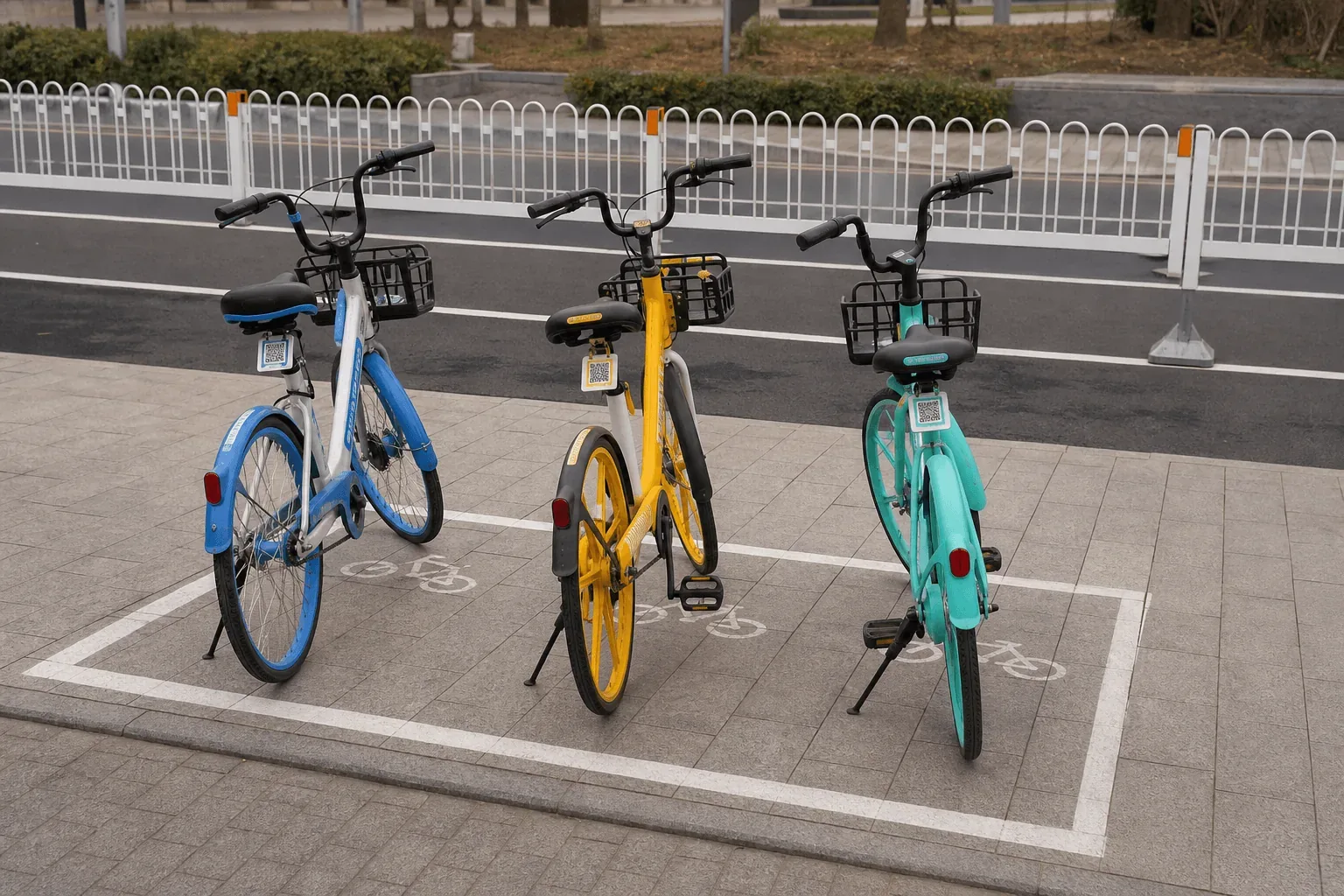
Blue is usually Hellobike
Blue bikes are commonly Hellobike. Alipay is the most convenient starting point for many international visitors. Open Transport, choose Bike or the Hellobike service, then scan the code on the bicycle. Some versions also let you search Alipay for 哈啰.
Hellobike has its own app, but a short-term visitor with a working Alipay account rarely needs another installation for one or two rides. Use the standalone app if the local Alipay route is unavailable.
Yellow is usually Meituan Bike
Yellow bikes are commonly Meituan Bike. The most dependable route is the cycling service inside the Meituan app. The first ride may require a phone login, camera and location permission, real-name verification and a payment method.
Some cities or bicycles can also open Meituan through an Alipay or WeChat Mini Program. That is a partner route rather than a universal rule. Scanning a yellow bike with Alipay does not guarantee that every account can unlock it.
Teal-green is usually Qingju Bike
Teal, turquoise or greenish-blue bikes are commonly Qingju. The usual official route is the DiDi app, Qingju app or the corresponding service page. Alipay and WeChat may open Qingju in some cities, but coverage and account requirements vary.
If the scan demands an app you do not have, look for a blue Hellobike or yellow Meituan bike nearby. Registering with several operators for a ten-minute journey is rarely worth the time.
Colour is only a clue. Confirm the operator, QR-code destination, bike number and unlock page. There is no nationwide rule that reserves one exact shade for one company.
Unlocking through Alipay
Alipay is friendly to international visitors and explicitly supports shared-bike payments. If registration, passport verification or card setup is unfinished, use our Alipay guide for foreign visitors first.
The usual route is:
- Open Alipay and enter
Transport. - Check the city at the top, then choose
Bike. - Activate the cycling service when prompted and allow camera, location and any required Bluetooth access.
- If identity verification appears, copy the name and document number from the passport. Do not shorten or rearrange the name.
- Tap
Scan to unlockand scan the code near the handlebar, frame or rear lock. - Check the operator, bike number, current fare and parking conditions before confirming.
- Wait for the unlock tone, then move the bike gently to make sure the lock has released.
In cities such as Beijing, Alipay may call several outside bike services. Elsewhere it may mainly show Hellobike. The available route changes by city and app release, so Alipay should not be treated as one national key for every bicycle.
Unlocking through WeChat
WeChat Scan can read the code on a bicycle and open the operator's Mini Program when that operator supports the route. It is not a nationwide bike pass, and it does not correspond to one particular bike colour.
Travellers who already use Weixin Pay can check our WeChat guide for foreign visitors, then try the following:
- Open WeChat
Scanand scan the code attached to the bike. - Read the name of the Mini Program before opening it. It should match the operator on the frame.
- Sign in and grant the location and camera permissions requested by the official service.
- Complete identity and payment setup if required.
- Check the bike number and fare before unlocking.
You can also search WeChat for the operator, but prefer a verified Mini Program with the same name as the bicycle. Search results can include coupons, advertising and third-party services. Do not submit a passport or bank card to a page whose operator is unclear.
If a scan opens a plain webpage, asks for another app, or rejects an international account, use the operator's main route. Try Alipay for a blue Hellobike, Meituan for a yellow bike, and DiDi or Qingju for a teal-green bike.
Using Meituan for a yellow bike
Meituan combines restaurants, delivery, local deals and transport. For a yellow Meituan Bike, its own cycling section leaves the least room for confusion.
- Sign in to Meituan. The first login normally uses a mobile number and SMS code.
- Search the home screen for
骑行or单车and enter Meituan Bike. - Allow camera, location and Bluetooth access. The map shows nearby bikes and the operating area.
- Complete real-name verification if requested. The service may ask for a legal name, identity document or another identity factor.
- Tap the scan button and scan the code on the yellow bike.
- Check the bike number, price and return area, then unlock.
Meituan's service can also appear through related WeChat pages or Mini Programs and may use Weixin Pay or Alipay at checkout. Keep the two jobs separate in your mind: the service that unlocks the bicycle and the payment method used for the final charge are not necessarily the same company.
Check the bike before moving
An unlocked bike is not automatically a safe bike. A half-minute inspection can prevent a breakdown halfway through the ride.
- Squeeze both brake levers and feel for firm resistance.
- Check for a flat tyre or visibly bent wheel.
- Turn the handlebar and make sure the steering moves normally.
- Set the saddle height and close the quick-release clamp firmly.
- Look for loose pedals, chain parts or basket fittings.
- Check that another sticker has not been placed over the QR code. Use another bike if the code looks replaced, lifted or suspicious.
Report a faulty bike in the app and choose another one. If the phone says it is unlocked but the physical lock has not released, use the fault option rather than kicking or pulling the lock.
One phone normally opens one bike at a time. Each traveller should use their own account. Do not send a dynamic page or QR screenshot to another rider.
Riding on the street
Use the non-motor-vehicle lane and travel in the direction of traffic. Obey signals. Where there is no marked cycle lane, follow local signs and keep to the right with care. Do not ride against traffic, run red lights, enter an expressway or speed along a pavement.
Do not hold a phone while moving. Check the route before starting and stop somewhere safe before changing navigation. Follow local signs that require cyclists to dismount at pedestrian crossings, footbridges or underpasses.
A standard shared bike carries one person. The basket is not a child seat. Do not carry a passenger or hang luggage from the handlebar. A large backpack, suitcase or loose clothing can interfere with steering and wheels, making the metro or a taxi the better choice.
Helmet rules differ by city and by vehicle type. A pedal bike without a supplied helmet is not risk-free. If the route is complex, traffic is heavy or urban cycling feels unfamiliar, use another form of transport.
Returning the bike means ending the order
Billing stops only when the bike is in an approved location and the platform receives the lock confirmation. Before reaching the destination, look in the app for a P marker, parking bay or operating-area boundary.
- Put the bike completely inside a painted non-motor-vehicle parking bay and align it with the other bicycles.
- Keep tactile paving, metro entrances, fire routes, junctions and shop doors clear.
- Follow the bicycle and app instructions. Some rear locks close by hand; other bikes finish through an electronic lock.
- Wait for
Ride ended,Return successfulor the final charge. - If the app requests a parking photo, include the whole bike and the boundary lines.
- Check the order once more before walking away. A lock sound alone does not prove that billing has stopped.
Many cities use geofenced parking. Outside the permitted area, the platform may refuse the return, continue charging or add a relocation fee. If the phone's location drifts, move the bike towards the centre of the marked bay, turn on location and Bluetooth, then try again.
If the lock or return fails
Stay with the bicycle. Check the rear lock for an obstruction, confirm the bike is fully inside the parking zone and try the return once more. If mobile data is weak, change connection and wait for the order status to refresh.
If it still fails, open customer service, fault reporting or abnormal return from the current order. Upload the parking location and a clear photograph. Keep the bike number, time, map position and parking photo. Closing the app or uninstalling it does not stop a server-side order.
When the bicycle is physically locked but billing continues, appeal from that same order. Do not scan another bike. An unfinished order often prevents the next unlock.
Fares, passes and deposits
Shared bikes normally charge by time. Starting periods, overtime charges, relocation fees and promotions vary by city, operator, vehicle and date. Check the price before unlocking and use the fare rules shown for that ride.
Pay-as-you-go is simplest for a short visit. Before buying a day, week or monthly pass, check the eligible city, vehicle type, included time and automatic-renewal terms. A pass may exclude electric-assist bikes or stop working in another city.
Some services decide whether to request a deposit based on identity, credit or local rules. A foreign bank card that handles ordinary mobile purchases may still fail for a pass, pre-authorisation or automatic payment. Try another official route or operator instead of submitting several variations of the passport name.
Where international visitors get stuck
The SMS code never arrives
Check the country code, roaming and message filtering. If the registration screen does not offer your country code, that route may not accept the number. Alipay or another operator is likely to be quicker.
The form accepts only a Chinese resident ID
Bike services commonly require real-name and age checks, but passport support varies by platform, city and Mini Program. Do not enter a false number. Use an official route that accepts a passport, choose another operator or take other transport.
The overseas card is declined
First check whether ordinary Alipay or Weixin Pay purchases work. The bike service may require automatic payment, pre-authorisation or a local method. A successful shop purchase does not guarantee that every cycling pass or Mini Program accepts the same card.
The page is only in Chinese
Alipay and WeChat have translation tools, but machine translation is not enough for prices, renewals and parking rules. Before unlocking, confirm the bike number, per-ride fare, operating area and return requirement. Paying for one ride is safer than buying a pass whose key terms are unclear.
Four points to remember
- Blue is commonly Hellobike, so try Alipay first. Yellow is commonly Meituan, so use Meituan first. Teal-green is commonly Qingju, so start with DiDi or Qingju.
- WeChat can scan a supported bike code and open a Mini Program, but it has no fixed colour and cannot be assumed to unlock every operator.
- Check the brakes, tyres and lock before riding. Use the cycle lane and put the phone away while moving.
- Do not leave until the order says it has ended. The parking lines, geofence and final receipt matter more than simply putting the bike down.
Official references
- How to use shared bikes, International Services Shanghai, updated in 2026 with the common colours, main access routes and scanning process for Hellobike, Meituan Bike and Qingju Bike.
- Transportation, Beijing International Web Portal, showing an international visitor workflow for scanning blue, yellow and teal bikes through Alipay and returning them inside painted bays.
Operator coverage, paint schemes, app routes, accepted identity documents, overseas cards, fares and parking zones change by city and date. Follow the name on the bicycle, the official app or Mini Program, and the local road signs in front of you.