

Journey To ChinaLast updated
The short answer
Visitors have three practical ways to get online in mainland China: keep their home carrier and use international roaming, install a travel eSIM, or buy a mainland Chinese SIM card after arrival. All three provide mobile data. The real differences are cost, whether you keep receiving messages on your home number, whether you get a Chinese +86 number, and how the connection is routed.
For most trips lasting a few days or a few weeks, the most useful setup is a travel eSIM for data with the home SIM left active for text messages. It is usually cheaper than roaming for the whole trip, and the physical SIM can stay in the phone.
If the phone does not support eSIM, or the visit is short and an employer is paying, international roaming is the simplest option. A mainland SIM makes more sense for a stay of several months, frequent local calls, or services that require a +86 number.
| Option | Relative cost | Setup | Home number and SMS | Chinese +86 number |
Access to overseas services | Best suited to |
|---|---|---|---|---|---|---|
| International roaming | High | Easiest | Kept; check call and SMS charges with the home carrier | No | Usually follows the home carrier's roaming route; depends on the plan | Short business trips and travellers who value simplicity |
| Travel eSIM | Low to medium | Needs a compatible, unlocked phone | Home SIM can remain active on a dual-SIM phone; prevent it from using data | Most data-only plans do not include one | Many plans use offshore roaming routes, but this is not guaranteed | Most short-term visitors; the usual first choice |
| Mainland Chinese SIM | Low | Passport and real-name registration required | Depends on the phone's dual-SIM support | Yes | Uses the mainland network environment, so some overseas services behave differently | Longer stays, study, work, or anyone needing a local number |
The overseas-service column is guidance, not a promise. Routing is chosen by the carrier or eSIM provider, and even two China plans sold by the same company may work differently. Read the exact plan terms before buying and ask the provider if the route is unclear.
Option 1: international roaming
Roaming changes the least. Ask the home carrier to enable roaming in mainland China before departure, then turn on the phone and data roaming after landing. The phone connects to a partner network while the existing number remains active for family, banks and account messages.

Why it is convenient
There is no card to replace and no new activation process to learn. The phone will normally search for a partner network as soon as it is switched on. That convenience can justify the price on a two-day business trip, particularly when an employer covers the bill.
Keeping the home number is useful for bank codes, airline messages and sign-in texts from services at home. Receiving SMS does not mean every registration will work, however. Alipay and WeChat accept overseas mobile numbers, while some Chinese services require a +86 number or additional identity checks.
Five questions to ask before departure
- Does the plan explicitly cover mainland China, rather than simply saying “Asia”?
- How much high-speed data is included per day or per trip, and what happens after the allowance is used?
- What are the charges for receiving SMS, answering calls and making calls?
- Is tethering allowed, and does it have a separate allowance?
- When does the plan begin: at purchase, on arrival, or at the first network connection?
Some carriers slow the connection sharply after the high-speed allowance is gone. Messaging may still work, but maps, passport uploads and video calls can become frustrating. Check the fair-use and speed restrictions behind any “unlimited” claim.
Overseas apps and services
Roaming data is commonly routed by the home carrier or one of its partners, so many travellers can continue using familiar overseas services. This is not consistent across every carrier and plan. Ask the carrier how its China roaming data is routed and whether it imposes service restrictions.
Mainland China has local rules for internet access. Whichever connection you choose, follow Chinese law and the carrier's terms.
The main drawbacks
Price is the obvious one. Even with a daily or weekly pass, a longer trip can cost much more than a travel eSIM or local plan. Background data is another risk: photo syncing, system updates and autoplay video can use a high-speed allowance before you notice.
Turn off automatic app updates and cloud photo backup before landing. On arrival, read the carrier's welcome message and confirm that the package is active before enabling data roaming.
Option 2: a travel eSIM
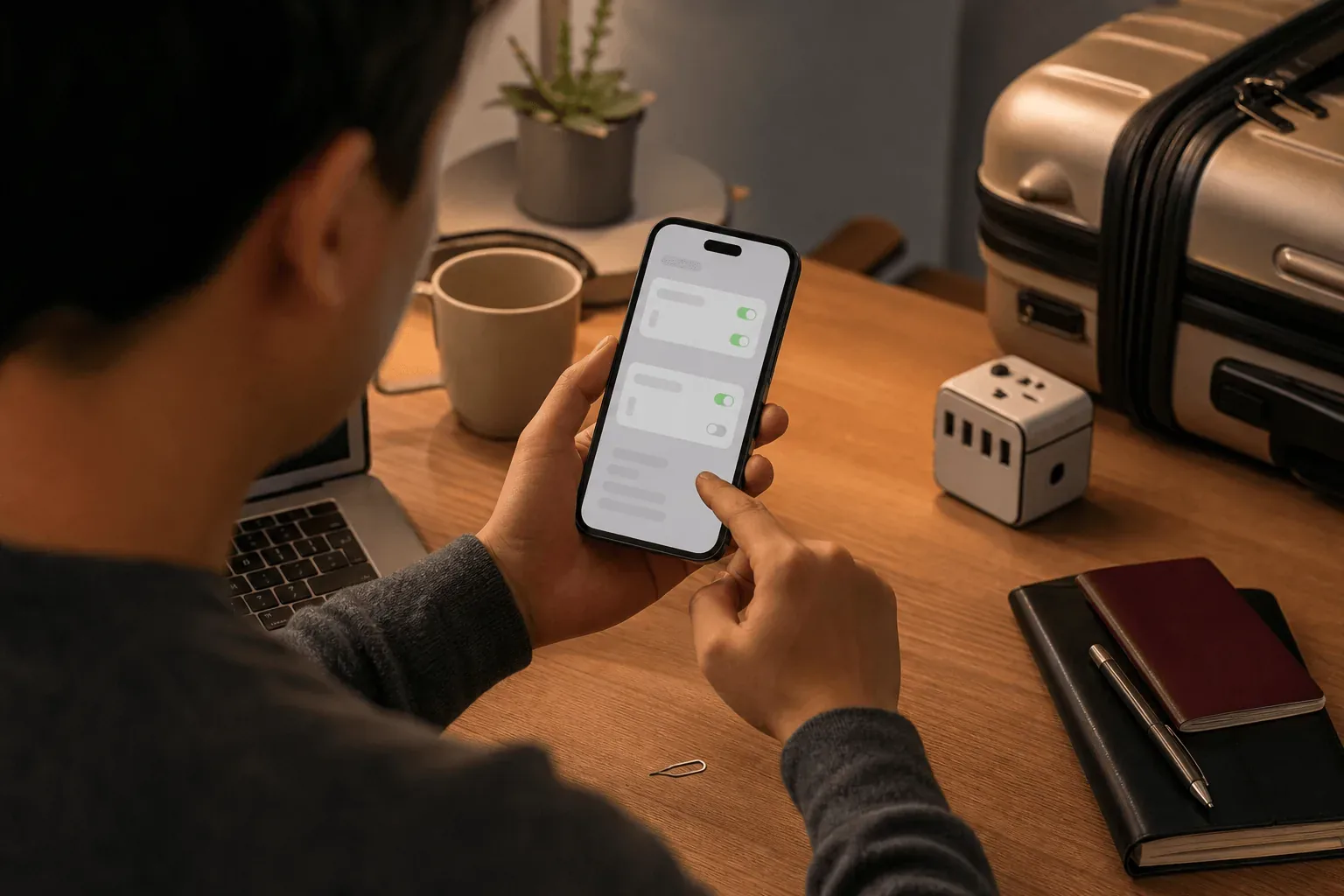
A travel eSIM is a digital SIM installed on the phone, with no plastic card to insert. After buying a China plan, the provider normally supplies a QR code or an installation flow in its app. Once it is installed, select the travel eSIM as the mobile-data line.
For most visitors, this offers the best balance of price and convenience. The phone must support eSIM, be unlocked from its carrier, and actually have eSIM enabled for the market in which that model was sold.
Check the exact phone first
Support on iPhones, Pixel phones and other Android devices varies by model, sales region and carrier. Do not rely on the product family alone. The same generation of phone may have a different SIM configuration in another market.
Look in Settings for an option such as Add eSIM, Add Mobile Plan or Download SIM, and check whether the device displays an EID. The handset must also be carrier-unlocked. The safest check is to give the manufacturer or home carrier the exact model number and country of purchase.
Most inexpensive plans are data-only
Many low-cost travel eSIMs provide data but no phone number. On their own they cannot receive ordinary SMS or answer calls to a Chinese number. A smaller number of plans include a number, calls or texts, but the product page should say so explicitly.
A data-only plan still connects maps, Alipay, WeChat, railway booking and ride-hailing apps. Leave the home SIM active when a verification message is needed. Apple's and Google's official instructions explain how compatible phones can assign separate lines for data, calls and messages, although the available combinations still depend on the device and carrier.
A sensible dual-SIM setup
- Install the eSIM on reliable Wi-Fi before departure. Do not delete it after installation; many QR codes cannot be reused.
- Check when the validity period starts. Some plans begin on the first connection in China, while others begin at installation or manual activation.
- After landing, select the travel eSIM for mobile data. Follow the provider's instructions on whether data roaming must be enabled for that line.
- Keep the home SIM on for incoming messages and calls, but turn off data roaming on the home line.
- Disable Cellular Data Switching, Backup Calling Data or the equivalent setting so the phone cannot quietly move data back to the expensive home SIM.
- Test the setup: open a map, send a message, then confirm that the home number can still receive an SMS.
Leaving the home SIM switched on does not always mean zero cost. Many carriers receive SMS free of charge, but incoming calls, voicemail, outgoing messages or Wi-Fi Calling may incur fees. Confirm these charges before travel.
Compare more than the data allowance
Two plans advertising 10 GB can deliver very different experiences. Compare the partner networks, 5G support, tethering rules, speed caps, validity period, refund terms and customer support. “Unlimited” plans often slow down after a daily threshold.
Also check how the China plan is routed. Many travel eSIMs use an offshore roaming route that makes familiar overseas services easier to reach, while others use a different arrangement. If the product page is vague, ask support rather than guessing from the brand name.
When it is the wrong choice
- The phone does not support eSIM or is still carrier-locked.
- A
+86number is essential for local calls or a particular registration. - The trip requires a large amount of high-speed data for a long period, and renewals are poor value.
- The phone cannot keep the eSIM and home SIM active together, but the home number must remain available for verification codes.
Option 3: a mainland Chinese SIM card
China Mobile, China Unicom and China Telecom can issue local SIM cards to foreign visitors. China's 2025 guide for expatriates states that applicants can take a passport or foreign permanent resident identity card to a carrier service hall to obtain communication services.
A 2024 central-government update says service points have been added at major airports in several cities. Counter locations, opening hours, plans and the ability to process foreign passports can change, and not every airport or terminal has one. Check the website of the airport you will actually use. If there is no suitable airport counter, try a carrier-operated service hall in the city.

What to bring
- Your valid passport.
- An unlocked phone that supports the frequencies used by Chinese carriers.
- Payment for the plan and a payment method accepted by the outlet.
- Time for the in-person real-name verification required by the counter.
Prefer a carrier-operated service hall or an official airport service point. A small reseller may not know how to process a foreign passport. Check the airport or carrier website before travelling and, where possible, confirm that the branch accepts foreign documents.
Why a local SIM can be useful
Local plans are generally inexpensive and provide coverage and speeds suited to long-term use. More importantly, the SIM includes a Chinese +86 number for local messages, calls and some services that require a mainland number.
A +86 number still does not guarantee approval in every app. A service may also check a passport, bank card, residence status or Chinese identity card. Each platform sets its own rules.
The mainland network environment
A local SIM connects directly through mainland China's mobile network. This differs from home-carrier roaming and some offshore-routed travel eSIMs. Overseas websites, work systems or apps that you normally use may not connect in the same way, and availability can change.
Anyone who depends on an overseas work system, email provider or social platform should confirm a lawful, supported connection with their employer and service provider before choosing a local SIM. This guide does not recommend untrusted networking tools or explain how to bypass local rules.
Deal with the number before leaving
Short-term visitors should ask whether the plan is prepaid, renews monthly or can charge automatically, and how long an unused number remains active. A number that may be recycled should not become the only sign-in or recovery method for an important account.
Closing a longer-term plan may require an in-person visit with the passport. Ask how cancellation works when opening the account. It is much easier to settle at the counter than after leaving China.
You can combine the options
There is no need to choose only one.
- Travel eSIM plus home SIM: use the eSIM for data and the home SIM for verification texts. This is the easiest combination for many short visits.
- Mainland SIM plus home SIM: use the local line for data and Chinese calls while keeping overseas accounts tied to the home number. It suits a dual-SIM phone and a longer stay.
- Roaming as a fallback: install the travel eSIM and add a low-cost roaming safety net to the home line. If activation fails, the phone is not completely offline.
- A second phone: when a work number cannot be interrupted or the main phone cannot support the right dual-SIM combination, a spare handset can be simpler.
With two active lines, explicitly choose which one carries mobile data. Otherwise the phone may switch to the more expensive line when the preferred connection becomes weak.
A ten-minute pre-departure check
- Confirm that the phone is unlocked for another carrier's SIM or eSIM.
- Check the exact model's eSIM and dual-SIM dual-standby support.
- Save offline maps, the hotel address and important bookings where they open without a connection.
- Keep the home carrier's roaming support number and price terms.
- Install a travel eSIM early, but activate it according to the plan's validity rules.
- Turn off data roaming, cellular-data switching and unnecessary background syncing on the home SIM.
- Keep a number that can receive SMS; do not rely only on a data-only eSIM.
- If buying a local SIM, check the airport or carrier-operated service hall, opening hours and passport requirements.
Official sources
- Chinese Government: A Guide to Working and Living in China as Business Expatriates 2025 explains how foreign nationals can apply for a SIM at the three main carriers using a passport.
- Chinese Government: China makes efforts to facilitate cross-border travel reports telecom service points at major airports in several cities; check the specific airport separately.
- Apple Support: Using Dual SIM with an eSIM covers line selection for data, calls and messages on compatible iPhones.
- Google Pixel Help: How to use dual SIMs explains eSIM and dual-SIM line selection on compatible Pixel phones.
Prices, coverage, speed limits, validity periods, SMS charges and airport counters can change. Check the carrier's or eSIM provider's current terms before buying.