
Journey To ChinaLast updated
Understanding China's main public holidays
China's nationwide holidays include New Year's Day and National Day as well as traditional festivals such as Spring Festival, Qingming, the Dragon Boat Festival and the Mid-Autumn Festival. People travel home, honour ancestors, watch dragon-boat races, attend lantern fairs and share seasonal food, so the atmosphere changes noticeably through the year.
China publishes a detailed holiday calendar annually. Weekends may be joined to the holiday and other weekend days designated as working days, creating a continuous break that is longer than the festival itself. The table below describes the usual pattern; exact dates should always be checked against the State Council schedule for the year of travel.
| Holiday | Usual timing | Typical continuous break | Main character |
|---|---|---|---|
| New Year's Day | Around 1 January | 1–3 days | Gregorian New Year, with countdown events in some cities |
| Spring Festival | Between late January and mid-February, depending on the lunar calendar | About 8–9 days | China's most important traditional festival and the peak season for family reunions |
| Qingming Festival | Usually between 4 and 6 April | About 3 days | Tomb sweeping, remembrance and spring outings |
| Labour Day / May Day | Around 1 May | Usually about 5 days | One of the country's busiest leisure-travel periods |
| Dragon Boat Festival | Fifth day of the fifth lunar month | About 3 days | Zongzi, commemorative traditions and dragon-boat races |
| Mid-Autumn Festival | Fifteenth day of the eighth lunar month | About 3 days | Family reunions, moon viewing and mooncakes |
| National Day | Beginning 1 October | Usually 1–7 October | The October Golden Week and one of the year's busiest travel periods |
Spring Festival, the Dragon Boat Festival and the Mid-Autumn Festival follow the lunar calendar, so their Gregorian dates change each year. Weekend connections and adjusted working days around May Day and National Day also depend on the annual announcement.
New Year's Day
New Year's Day marks the start of the Gregorian year. In ancient China, the term yuandan referred more generally to the beginning of a year, and its date changed with calendars and dynasties. After China adopted the Gregorian calendar, 1 January gradually became known as New Year's Day, while the lunar new year became Spring Festival. Today's New Year's Day is therefore a modern new-year holiday rather than a festival with the extensive traditional customs of Spring Festival.
People now welcome the year with countdowns, concerts, new-year markets and short trips. The break is brief, and crowds are concentrated in shopping districts, theme parks and countdown venues, particularly from the evening of 31 December through 1 January. Most attractions and businesses remain open, sometimes with adjusted hours.
Spring Festival
Spring Festival begins the lunar new year and is China's most important traditional holiday. Its many days of celebrations centre on bidding farewell to the old year, welcoming the new one, seeking good fortune, reuniting families and renewing community ties. Preparations begin with cleaning homes and buying provisions before families gather on Lunar New Year's Eve and exchange visits in the first lunar month. In 2024, “Spring festival, social practices of the Chinese people in celebration of traditional new year” was inscribed on UNESCO's Representative List of the Intangible Cultural Heritage of Humanity.
Families share a reunion dinner and stay up to welcome the new year on New Year's Eve. During the festival, people hang red couplets and the character for good fortune, give children red envelopes and visit relatives and friends. Flower markets, temple fairs, lantern displays, dragon and lion dances and other heritage activities vary widely between regions. Spring Festival is not limited to a single day: its atmosphere often extends from preparations before the new year through the Lantern Festival, in big cities as well as counties and villages.
The period before and after the holiday brings a very large homecoming and return-travel movement. Demand for long-distance trains and flights rises, while some independent restaurants, neighbourhood shops and smaller services close or reduce their hours. Major attractions generally remain open, but their hours and reservation arrangements need to be checked individually.
Qingming Festival
Qingming is both a point in the traditional solar-term calendar and a festival, usually falling between 4 and 6 April. Arriving between mid- and late spring, it reflects the return of warmer weather and new growth while carrying a tradition of remembering ancestors and departed relatives. Tomb sweeping is its central observance: families tend graves, present flowers or commemorate the dead in other ways.
Qingming is also a time to enjoy spring. Outings, blossom viewing and kite flying coexist with the solemn rituals of remembrance, giving the festival both reflective and lively sides. Customs vary by region, but remembrance and spring outings are its most widespread themes. In good weather, parks, suburban attractions, roads near cemeteries and short-distance transport can be busier than on an ordinary weekend.
Labour Day / May Day
Labour Day falls on 1 May and is also known as International Workers' Day. It commemorates workers and the history of the campaign for labour rights. China began holding May Day commemorations in the early twentieth century and formally designated 1 May as Labour Day in December 1949. Because it did not develop from a traditional calendar or folk observances, it has no nationwide set of customs comparable with Spring Festival or the Dragon Boat Festival.
Some places now hold activities honouring workers, but for most visitors the holiday's most visible feature is the concentration of leisure time and travel. May Day usually creates a continuous break of about five days. As the weather becomes warmer, city breaks, theme parks, historic towns, mountain areas and coastal destinations all enter a clear travel peak.
Popular attractions may fill their reservation capacity, convenient train and flight choices become scarce, and hotels in central or scenic locations sell out quickly. At a sought-after destination, a particular hotel and room type may cost twice its ordinary non-holiday rate or more.
Dragon Boat Festival
The Dragon Boat Festival falls on the fifth day of the fifth lunar month and has a long history in China. It did not arise from a single story, but brings together traditions of commemorating respected figures, responding to the season and praying for health and safety. The figures remembered vary between regions. The best-known is the Warring States poet Qu Yuan, whose story is particularly closely associated with festival traditions in Hubei and Hunan.
Dragon-boat racing and eating zongzi, parcels of glutinous rice wrapped in leaves, are the festival's most recognisable customs. Folk stories connect boat races and offerings of rice with the search for and remembrance of Qu Yuan after he drowned. Hanging mugwort and calamus and wearing scented sachets reflect older early-summer wishes to repel insects and disease and keep families safe. The shape, filling and flavour of zongzi vary across China, while dragon-boat events are especially common along the middle and lower Yangtze and in southern water towns.
Mid-Autumn Festival
The Mid-Autumn Festival falls on the fifteenth day of the eighth lunar month. The eighth month lies in the middle of autumn and its fifteenth night is close to the full moon, giving the festival its name. It gradually developed from ancient autumn moon worship and harvest celebrations; moon viewing became increasingly popular in the Tang dynasty and spread more widely into everyday life after the Song dynasty.
The full moon later became a symbol of reunion, and Mid-Autumn is consequently also known as a reunion festival. Gathering with family, viewing the moon and eating mooncakes are its most widespread customs. Regional traditions also include making offerings to the moon, enjoying osmanthus flowers and wine, fire-dragon dances and Beijing's rabbit figurines. Gardens, old towns, lakesides and attractions offering evening programmes may stay open later and receive more local visitors. In some years the festival falls close to National Day and becomes part of a longer break.
National Day and the October Golden Week
National Day falls on 1 October and commemorates the founding of the People's Republic of China. On 2 October 1949, the Central People's Government passed a resolution designating 1 October as National Day each year. It is a national commemorative holiday, distinct from traditional festivals such as Spring Festival, Qingming, the Dragon Boat Festival and the Mid-Autumn Festival.
During National Day, flags and holiday decorations appear across the country. Some cities hold flag-raising ceremonies, performances, light shows or themed exhibitions, while museums, historic sites and public spaces may offer special programmes. The holiday begins on 1 October and usually continues through 7 October, giving rise to the name October Golden Week.
It is also one of China's most concentrated travel peaks. Beijing, Shanghai, Xi'an, Hangzhou, Chengdu, Chongqing, Zhangjiajie, Guilin and other leading destinations receive substantially more visitors. Famous attractions can reach their reservation limits as hotel prices and transport demand rise at the same time.
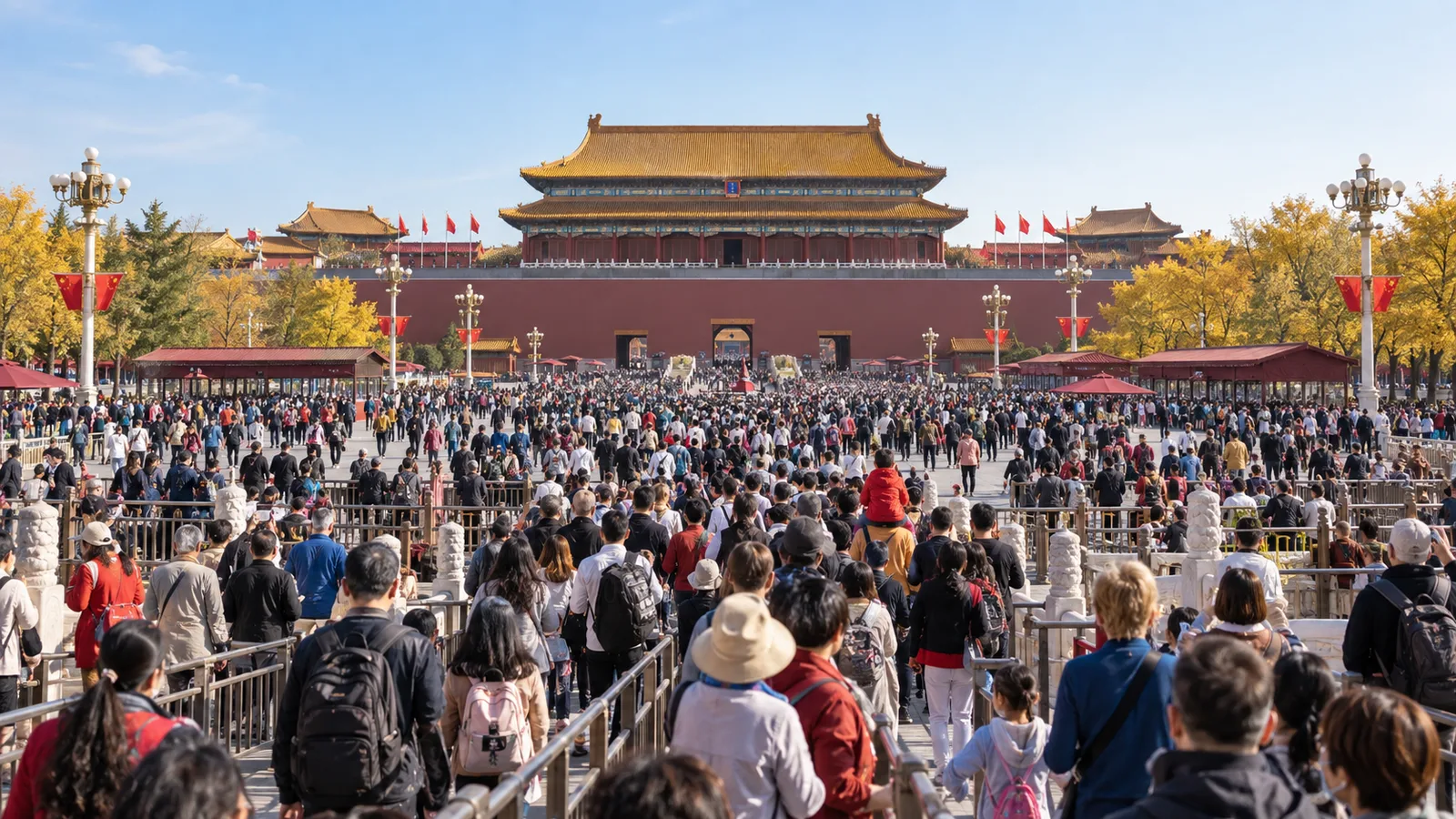
Even when crowds remain orderly, visitor numbers during National Day can make a famous attraction much less enjoyable.
A holiday warning when planning a China trip
If your dates are flexible, try to avoid the May Day break and the period around 1–7 October. Large numbers of residents travel at the same time, making famous attractions crowded and trains, flights and hotels harder to book. Some hotel rates can also be substantially higher than on ordinary dates.
Long-distance transport is similarly busy before and after Spring Festival. Visitors who want to experience the celebrations can still travel then, but should allow more time and confirm the opening arrangements for attractions, restaurants and accommodation.
Qingming, the Dragon Boat Festival and the Mid-Autumn Festival are shorter breaks whose effects are more concentrated on nearby trips, event destinations and the first and last days of the holiday. Whatever year you travel, check that year's official holiday announcement before fixing transport and accommodation dates.