Journey To ChinaLast updated
Alipay transit code and single-journey tickets
Visitors who have completed Alipay identity and payment setup can open Transport, choose Beijing and Metro, then activate the local transit code. Scan the same account when entering and leaving. The transit code is different from the ordinary merchant payment QR code.
A single-journey ticket is the direct alternative when the transit code is not set up. Ticket machines generally offer an English interface: choose the destination and passenger count, then use an accepted payment method. Staffed counters can help with the Chinese station name. Tap the physical ticket to enter and follow the gate instruction to return it on exit.
Beijing also supports contactless bank cards from China UnionPay, Mastercard, Visa, JCB and American Express at equipped gates, as well as BEIJING PASS. Each passenger uses one card and keeps the same physical card or phone-wallet device for both ends of the journey. A failed gate can be checked at the service counter without changing payment media mid-trip.
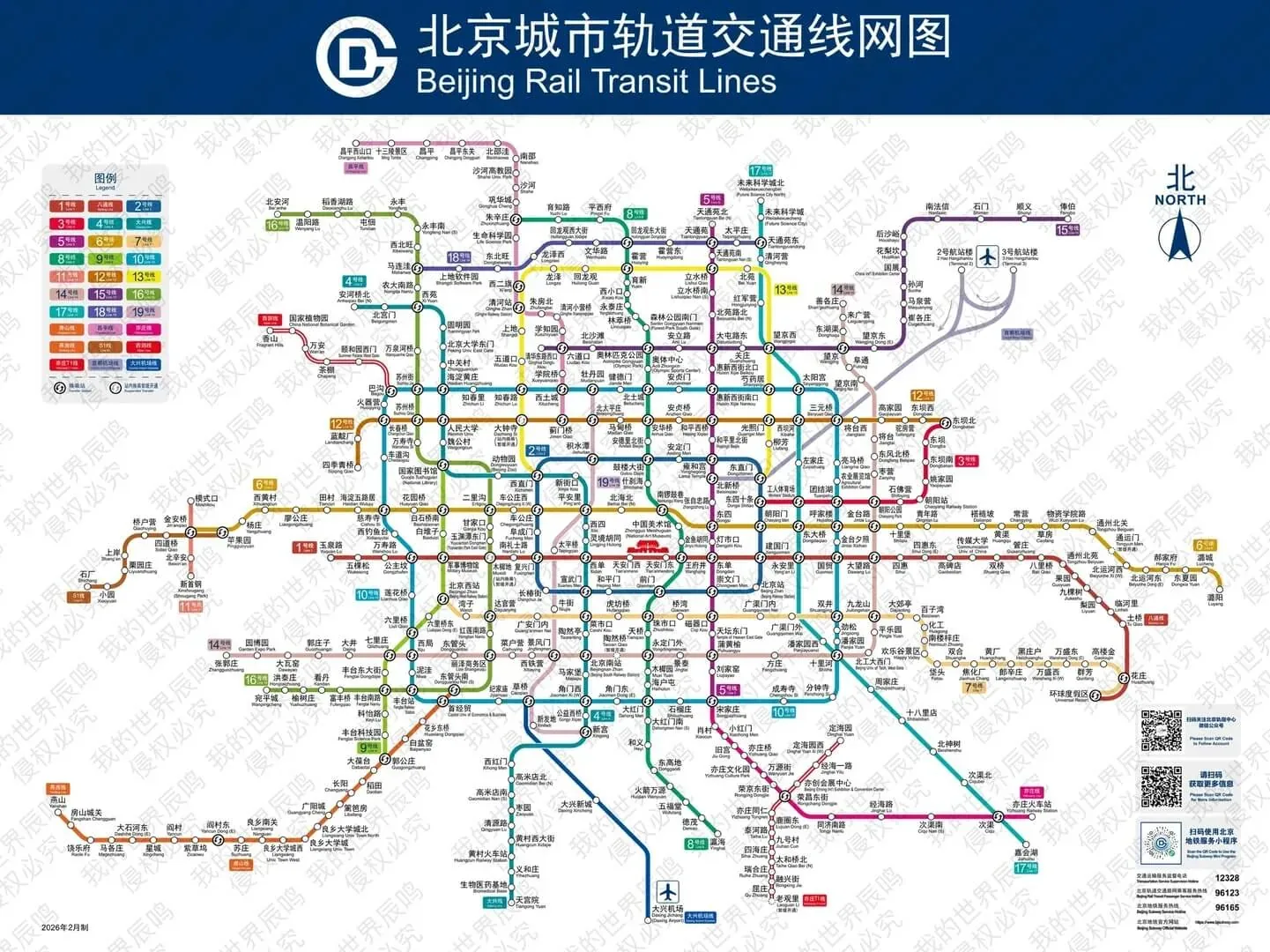
Use the network map for lines and interchanges. Street exits, walking distance and temporary closures need the current operator notice and navigation map.
Corridors linking major sights and hubs
Line 1 follows Chang'an Avenue through Tian'anmen and Wangfujing towards the CBD. Line 2 circles the inner city and connects Beijing Station, Qianmen, Xizhimen and Dongzhimen. Line 4 links Beijing South, Xidan, the National Library and the Summer Palace direction; Line 5 serves Beixinqiao, Dongsi and the Temple of Heaven.
Line 8 links Qianmen, Nanluoguxiang, Shichahai, the Drum Tower area and Olympic Park. Line 10 connects Sanyuanqiao, the CBD, Caoqiao and Fengtai; Line 19 provides a faster north-south corridor from Caoqiao. Line 3 now reaches Beijing Chaoyang station.
One interchange can include a long walk
Xizhimen, Guomao and Caoqiao involve corridors, level changes and crowd flow that are not visible in a small interchange symbol. Lift locations can be checked in advance for step-free travel, luggage and pushchairs. Sometimes a route with one fewer interchange and a slightly longer street walk is simpler.
Exit letters and numbers determine the side of a divided road, security perimeter or railway complex. Enlarge the destination on the map before arrival and record the full exit code.
First and last trains depend on station and direction
Last-train times differ by direction and station. A passenger may enter one line near closing time only to find the connecting line has finished. Airport expresses have their own operating patterns. Event extensions apply only on the announced dates, so check the operator on the day of a late flight, train or performance.
Every entry includes security screening. Large luggage, liquids and restricted items may require additional inspection. Central lines are most crowded during commuting periods; current notices and the station environment give the best indication of temporary controls.